The Tuesday Standard: Building Hair That Works When Nothing Special Is Happening

Photo by Photo by Richmond Fajardo on Unsplash on Unsplash
There is a certain kind of hair that only shows up when there is a reason. A wedding. A holiday party. A photo that will live on someone's fridge. It looks incredible for six hours and then goes back in a claw clip until further notice. That is not a signature look. That is a costume.
A real signature look is the hair you wear on a Tuesday. The one that has to survive a 7:40 a.m. school drop-off, a full workday, a Target run for the thing you forgot, and a text at 4:30 p.m. asking if you want to grab dinner. If your hair only works for special occasions, the problem is not your styling skills. The problem is that the cut, color, and routine were designed for a life you do not actually live.
At Naomi & Company Hair Design, we are not against getting dressed up. We are simply suspicious of hair that needs an invitation to look good. Here is how to build a look that shows up for ordinary days—and still looks polished when something better comes along.
Special-Occasion Hair Is a Trap
Special-occasion hair usually has three features: it takes a long time, it depends on perfect conditions, and it falls apart if the weather changes or you have to run an errand. It is impressive, but it is not practical. And practical is not a dirty word. Practical is what lets you leave the house feeling put together on a day when you have exactly nine minutes to get ready.
The better goal is a look with a strong foundation. That means a shape that holds its line as it grows, a color that does not demand a salon visit every three weeks, and a styling routine simple enough that you will actually repeat it. Think of it as your Tuesday standard—the baseline you can hit without a countdown timer.
The Tuesday Test: Start With Your Real Week
Before you book your next appointment, run your hair through a normal week. Not the week you wish you had. The real one.
Do you wash your hair at night or in the morning? How much time do you have on a weekday morning—five minutes, fifteen, or the time it takes to brush your teeth while answering an email? Do you exercise in the middle of the day? Do you have kids who need to be somewhere at a specific time? Do you work in an office, from home, or in a job where your hair needs to stay out of the way? Do you have a hair texture that changes dramatically in humidity or dry air?
Those answers matter more than a photo on a mood board. A cut that looks great in a salon chair but requires thirty minutes of round-brushing every morning is not a good cut for you. A color that needs a root touch-up every month is not a good color if your schedule is already full. The right look is the one that fits your week, not the other way around.
Cut: Design for the Days You Actually Have
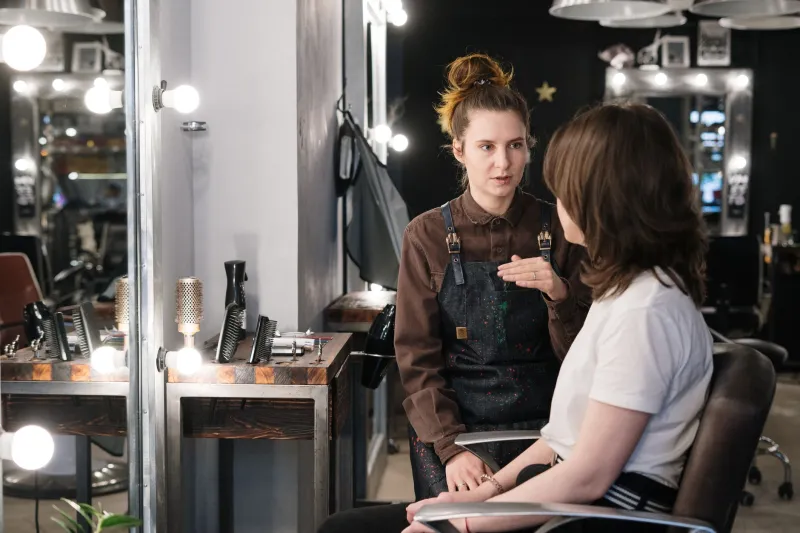
A signature shape is not about chasing a trend. It is about designing a cut with a clear line, an easy grow-out, and enough structure to look intentional without much effort. That might mean a blunt bob that holds its shape as it grows, a longer layered cut that can air-dry with a little help, or a short crop with a strong silhouette that needs a quick texture paste and nothing else.
When you talk to your stylist, be specific about your morning. Tell them how much time you have. Tell them whether you are willing to use a round brush, a flat iron, or a diffuser. Tell them if you usually let your hair air-dry and then panic. A good stylist will not just ask what you want; they will ask what your hair needs to do before 8 a.m.
This is also the moment to talk about grow-out. Your haircut is not a single day. It is a shape that has to look good in week one, week four, and week eight. Ask what the cut will look like when it starts to lose its edge. Ask how often you will realistically need a trim to keep the shape. Ask whether the style can be pushed back, tucked, or pinned on a day when you are running late.
Color: Choose a Plan, Not Just a Shade
Color is where a lot of everyday looks fall apart. Not because the shade is wrong, but because the maintenance was never part of the plan. A high-contrast color with a precise root line can look amazing—and also require more appointments than your calendar can handle. A softer, blended color may not have the same drama on day one, but it can look polished for months.
Ask your colorist to explain the grow-out, not just the first two weeks. How visible will the roots be? How often will you need a gloss or a touch-up? Can the color be refreshed with a simple at-home routine between visits? If you are covering gray, ask how the color will look as it softens. If you are going lighter, ask what happens when the summer sun or a chlorinated pool gets involved.
The best color for everyday life is not the one that looks most dramatic in the salon. It is the one that still looks intentional on a Tuesday when you have not had time to style it.
Styling: A Routine You Will Actually Repeat
Most people do not need more styling options. They need fewer, better ones. A signature look usually comes down to three moves: one for volume, one for smoothness, and one for the ends. That might be a root-lift spray at the crown, a light oil through the mid-lengths, and a quick pass with a round brush or flat iron on the front pieces. Or it might be a sea-salt texture spray, a diffuser, and a little cream to define the ends.
The key is to practice the routine on a day when you are not rushing. Learn what your hair does when it is 80 percent dry. Learn how much product is too much. Learn which side of your part behaves and which side needs a little extra attention. A five-minute routine that you understand is worth more than a thirty-minute routine you only attempt for events.
And do not forget the refresher. A good day-two plan is part of a signature look. Dry shampoo at the roots, a little water or leave-in conditioner on the ends, and a quick reshape can buy you another day. If your hair needs a full wash every day to look decent, that is useful information for your stylist. It may mean the cut or color needs adjusting, or it may mean the products are doing too much.
Questions to Bring to Your Next Consultation
You do not need to arrive with a full presentation. You just need to be honest about your life. Try these questions:
- What will this cut look like when I style it myself with the tools I actually own?
- How much time will this take on a normal weekday morning?
- What is the grow-out plan, and how often will I need to come back to keep the shape?
- How will this color look in four weeks, six weeks, and eight weeks?
- What is the simplest product routine for this look, and what can I skip?
- If I only have five minutes, what should I do first?
- What should I do on a day when my hair refuses to cooperate?
Those questions turn a consultation into a plan. They also give your stylist permission to steer you away from a look that photographs well but does not fit your routine. That is not a compromise. That is good design.
The Point Is Not Perfect
A signature look is not about walking out of the house looking like you just left a salon chair. It is about looking like yourself, on purpose, even when the day is ordinary. Some days that means a smooth blowout. Some days it means a messy bun with a sharp front edge. Both can be polished. Both can be yours.
The real luxury is not saving your best hair for a special occasion. It is knowing that your hair will show up for you on a Tuesday, in the rain, with ten minutes to spare. That is the standard worth building toward.