The Second Act: Rethinking Cut and Color When Your Hair Starts Changing With You
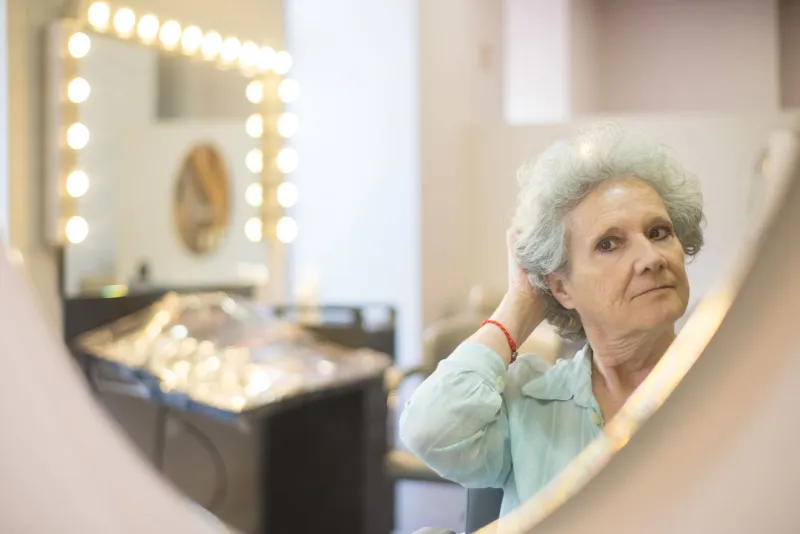
Somewhere in her forties, a client sits down and says a version of the same thing: "It's not the same hair anymore." And she's right. It isn't. The strand that used to hold a curl goes limp, the one that was smooth starts catching the light in a coarser way, and the gray that came in soft and silver keeps showing up with a wire-like personality of its own.
Here's the thing we say back, almost every time: your hair changing doesn't mean your style has to. It means the styling gets an update.
What's Actually Happening Up There
Estrogen and progesterone influence the hair's growth cycle, its thickness, and how oily your scalp runs. As those levels move through perimenopause, the results show up on your head long before they show up on any chart. Strands get finer individually even as the total can feel coarser. Density thins at the part, at the temples, sometimes at the crown. Many women notice more shedding during the transition, and a scalp that used to be oily and is now dry.
Gray hair isn't the villain here — but it has a different personality. It tends to be coarser, holds less moisture, takes color differently, and reflects light in a flatter way. It also resists styling a little. That's not damage. That's a different fiber.
And texture shifts are real. Curls that were loose can tighten. Straight hair can develop a wave. A head of hair that forgave a rough blow-dry at thirty-five gets noticeably less forgiving at fifty.
None of this is a decline. It's a different brief.
Why "Just Cut It Short" Isn't the Whole Answer
Short is a great option for some and a bad fit for others. What actually travels better through midlife is structure — a shape with some deliberate line and internal architecture, rather than a long, all-one-length cut relying on length to look like something.
A few shapes that tend to work while texture is in flux:
- A collarbone-length blunt or gently angled bob. The perimeter does the work, so fine strands read as fuller.
- A soft layered lob with face-framing pieces that start no higher than the cheekbone. Enough movement to keep it modern, low enough to avoid the frizz-bomb effect.
- A short textured crop with a slightly longer front. Excellent for coarse silver, since it leans into the natural volume instead of fighting it.
- A shoulder-grazing cut with an internal layer system. The easiest way to keep length while removing weight that's dragging the crown flat.
What we usually steer away from during this stretch is heavy, deep layering on fine hair. It reads as thin at the ends within two weeks and looks like a mistake for the next six.
The Color Conversation, Reframed
The two extremes — flat single-process color from root to tip, or letting gray grow out with no plan — are the ones that cause the most frustration. The middle ground is where the good stuff lives.
Consider blurring rather than covering. A soft root shadow that's within a shade or two of your natural tone lets growth come in without a hard line. You can stretch appointments to eight or ten weeks instead of six.
Use gray as a highlight, not a secret. Strategically placed lighter pieces around the face can make silver look like a deliberate, dimensional choice rather than an oversight. On the right head, this is the most flattering thing we do.
Understand what permanent color does to coarse gray. It covers, but it can also make those strands feel drier. A glossing service every so often adds back the light reflection that coarse hair loses, and it's the single biggest improvement most clients notice.
Ask about the transition, not just the result. If you're thinking about letting the gray come in, we can plan a lowlight-and-tone-down strategy over several visits instead of handing you a hat and a waiting period.
Products and Routine: Fewer, Better
Midlife hair tends to respond better to restraint than to a bathroom shelf full of bottles. Two things shift in priority: moisture and scalp care.
Coarse, graying hair drinks up a heavier conditioner or a weekly mask, and it usually loves a leave-in with a bit of weight to it. Fine hair in the same decade wants lightweight formulas and a volumizing mousse applied at the root, not a cream-based styler that will flatten things by noon.
The scalp deserves more attention than it usually gets. As oil production drops, dryness and flaking show up more often, and gentle exfoliation once a week keeps the follicle environment in good shape. In our chairs, a scalp-focused add-on during color appointments has become one of the most requested services, and for good reason.
On heat tools: lower the temperature and shorten the contact time. Coarse hair needs more heat to shape; fine hair gets damaged faster. Either way, a heat protectant isn't optional anymore.
Signs It's Time to Adjust Your Signature Look
Not every change is a crisis, but a few signals are worth acting on:
- Your usual cut needs styling every single day to look acceptable, when it used to work with a rough dry.
- Your part is widening, or you can see scalp at the crown in photos.
- The color you've worn for years suddenly looks harsh against your skin in daylight.
- Your waves are curling harder than your current shape can support.
- You're spending noticeably more time on your hair and liking it less.
If two or three of those are true, it's not a sign you need to cut it all off. It's a sign your shape and service plan need a re-read.
How to Ask for What You Need
The most useful thing you can do is describe the behavior of your hair rather than the outcome you want. "It's coarser at the front and falls flat at the crown" gives us more than "I need something younger." Bring a photo of your hair on a good day and a photo of it on a bad one. Bring a photo of yourself five years ago and tell us what you miss about it — sometimes what you miss is a styling habit, not a haircut.
And say the quiet part out loud. If you're not ready to go gray, say so. If you're tired of the roots, say so. If you love the silver but hate the texture, say so. Nothing about this decade of hair is one-size, and the plan gets better the more honestly you brief it.
The goal at Naomi & Company isn't to make you look like you did at thirty-five. It's to make the hair you have now look like a signature — deliberate, easy, and unmistakably yours.