Your Color Has a Night Shift: Judging Your Hair in the Light You Actually Live In
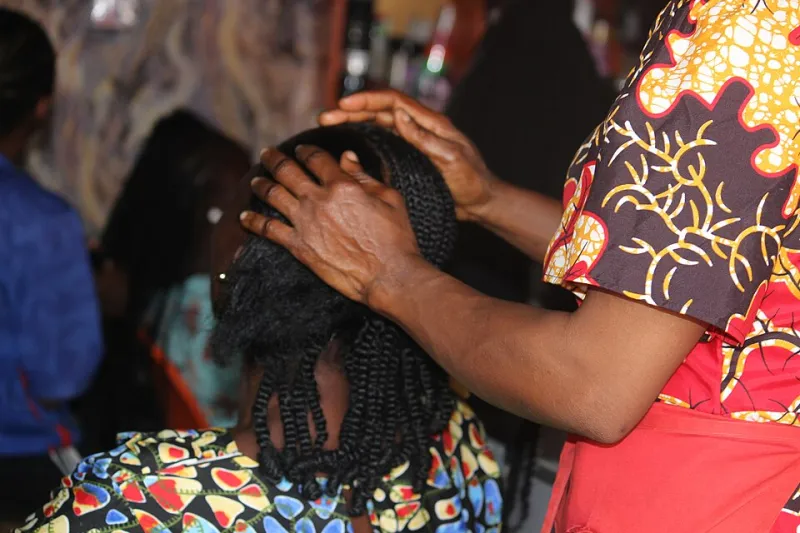
Photo: Umshushima, CC BY-SA 4.0, via Wikimedia Commons
You leave the salon feeling like the color is exactly right. Twenty minutes later, you catch your reflection in the car window and wonder if someone swapped your hair. By the time you are standing under the bathroom bulbs, the whole thing seems to have shifted again. Nothing went wrong. You are just seeing your color under a new set of lights.
Hair color is not a fixed paint chip. It is a surface that reflects light, and that light changes from room to room, hour to hour, and season to season. At Naomi & Company Hair Design, we would rather you know how to read those shifts than panic over them. A little lighting literacy goes a long way toward enjoying your color instead of second-guessing it.
Salon Lighting Is Designed to Flatter
Salon lighting is not neutral. It is usually layered, diffused, and angled to make hair look glossy and dimensional. That is not a trick, exactly, but it is a controlled environment. Mirrors are positioned to bounce light evenly, and the bulbs are chosen to soften shadows and bring out shine. Your color is going to look especially polished there. That is the point.
Home is a different story. Your bathroom might have warm bulbs that pull every golden tone forward. Your kitchen might have cooler LEDs that make ash tones look steelier. A hallway with no windows can flatten dimension until your color looks one-dimensional. None of these rooms is lying to you. They are simply showing you one version of the truth.
The Four Lights You Live With
Most people move through at least four lighting environments on a normal day, and each one treats color differently.
Bathroom bulbs. These are often warm and close to the face. They can make warm brunettes and blondes look richer, but they can also exaggerate brassiness or red tones. If your bathroom makes your color look hotter than you expected, check it against daylight before you decide anything.
Office fluorescents. Fluorescents are famously unkind. They tend to cool everything down and can make hair look flatter or greener, especially in cool-toned blondes and ash browns. If your color looks drab at your desk, that is often the lighting, not the formula.
Daylight. This is the most honest light you have. Indirect daylight near a window shows tone and dimension most accurately. Direct sun is too intense and will make even a subtle color look brighter than it is. Think of daylight as your reference point, not your courtroom.
Evening and ambient light. Restaurant lighting, lamps, and phone screens all push color in different directions. Warm ambient light can make a copper gloss glow; cool evening light can make a soft blonde look gray. Neither is a reason to call the salon.
What You Can Judge at Home
You can absolutely evaluate your color at home. You just need to know which questions are fair.
Fair questions include: Does the overall tone feel like what we discussed? Is the color even from root to end? Does the shine look healthy? Does the shade work with your skin in indirect daylight? Those are real, useful observations.
Less fair questions include: Does it look exactly like it did in the salon chair? Does it match the photo on my phone? Does it look the same in every room? The answer to all three is usually no, and that is normal. Salon lighting is a controlled preview, not a promise that every room in your life will behave the same way.
Wait Before You Call
Color needs a little time to settle. The first wash or two can shift the surface slightly, and your eyes need time to adjust to seeing a new shade on your own head. If something feels off, give it a few days and at least one wash before you decide it is a problem. Look at it in indirect daylight, not just in the mirror where you do your makeup.
Call the salon sooner if you see something structural: patchiness, a band at the roots, a tone that is dramatically darker or lighter than you discussed, or color that is transferring. Those are not lighting issues. But if the color simply reads warmer in your bathroom and cooler at the office, take a breath. That is the nature of hair color.
How to Photograph Color for Your Stylist
If you do need to send a photo, make it useful. Stand near a window with indirect daylight, turn off overhead lights, and face the camera straight on. Take one photo with your hair down and one with it pulled back so your stylist can see the root area. Do not use filters, beauty mode, or portrait lighting. Those settings are designed to flatter, not to document.
Take a second photo in the room where you think the color looks strangest. That contrast is helpful. Your stylist can often tell from two different lighting setups whether you are seeing a real issue or a reflection problem.
Describe Tone, Not Just Feeling
“It looks wrong” is hard to solve. “It looks warmer in my bathroom than in daylight” is something a stylist can work with. Try describing the direction: warmer, cooler, darker, lighter, more golden, more ashy, more red. Mention where you see it most. Mention whether it changes after a wash. That kind of detail helps your stylist decide whether you need an adjustment or simply a different light bulb.
Your color is going to have a night shift. It will look different at 7 a.m., 2 p.m., and 9 p.m., and that is part of what makes it interesting. The goal is not to chase one perfect lighting condition. The goal is to know which light is telling you the truth, which light is just being dramatic, and when to enjoy the show instead of calling the salon.